.svg)

Introduction:
One Business, Multiple Payment Models
Modern businesses rarely rely on a single revenue model.
An eCommerce store might sell products through one-time purchases while offering customers a monthly subscription for exclusive benefits. A software company might charge customers a one-time setup fee and then collect recurring subscription payments. Similarly, a digital agency might invoice clients for individual projects while offering ongoing monthly maintenance packages.
Although these business models create opportunities for growth, they also introduce operational challenges.
Managing one-time payments and recurring subscriptions through separate systems can lead to fragmented customer records, complicated financial reporting, manual billing processes, and unnecessary administrative work.
Businesses need a payment infrastructure that can handle different revenue models without making financial management more complicated.
This is where ZionPe comes in.
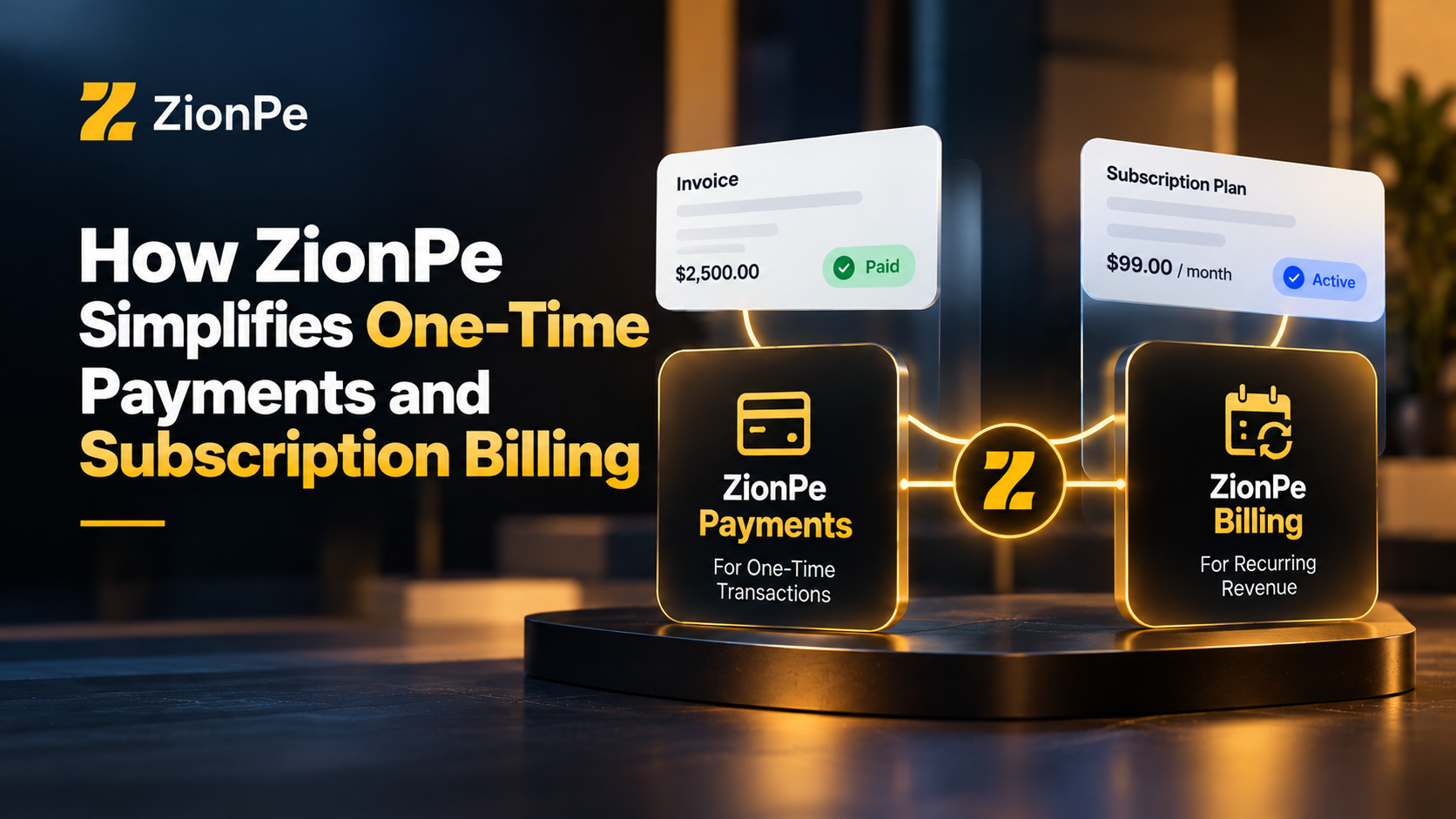
ZionPe is a unified payment and billing platform designed to help businesses accept payments, manage invoices, automate subscriptions, and monitor financial activity through a centralized dashboard.
With two complementary products, ZionPe Payments and ZionPe Billing, businesses can manage both one-time transactions and recurring revenue within the same platform.
Whether you operate an eCommerce store, a SaaS company, a digital agency, or a subscription-based service, ZionPe helps simplify the way you manage payments and billing.
Let's explore how.
1. Understanding the Two Main Business Payment Models
Before exploring how ZionPe works, it is important to understand the two payment models used by modern businesses.
One-Time Payment Business Models

A one-time payment model involves charging customers a single amount for a product, service, or transaction.
Once the customer completes the payment, the transaction is considered complete unless additional purchases or charges occur.
This model is commonly used by:
- eCommerce stores selling physical products.
- Digital product sellers offering templates, software licenses, and downloadable resources.
- Freelancers charging for individual projects.
- Consultants offering one-time consultations.
- Agencies charging for specific projects or deliverables.
- Businesses selling tickets, courses, or individual services.
For these businesses, the primary payment management requirements include accepting payments, generating invoices, tracking transactions, managing customers, and monitoring payouts.
Subscription-Based Business Models
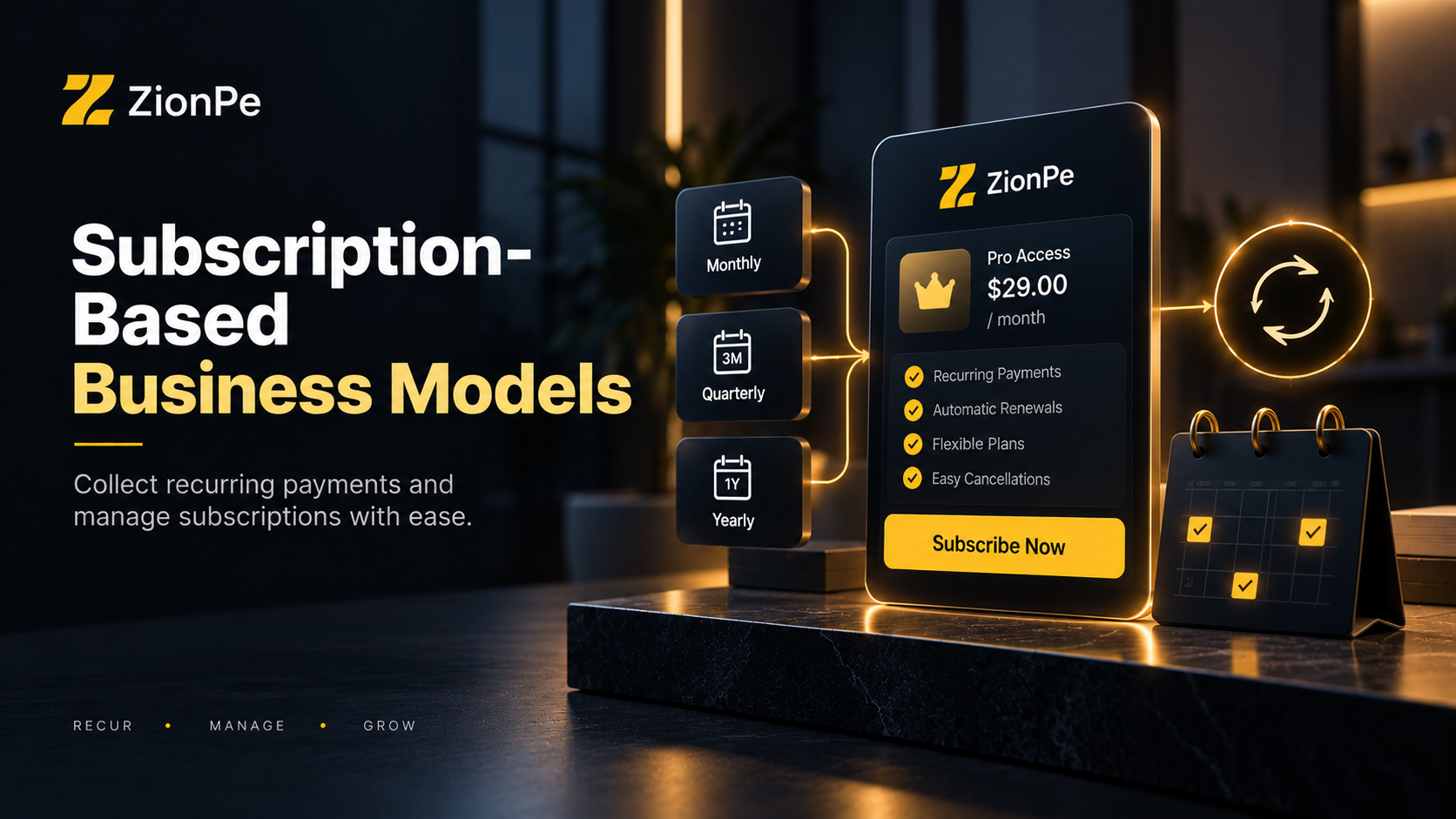
A subscription-based business model generates revenue through recurring payments collected at predefined intervals.
Customers typically pay monthly, quarterly, or annually to access a product, service, or membership.
Examples include:
- Software-as-a-Service (SaaS) platforms.
- Membership websites.
- Cloud hosting providers.
- Online learning platforms.
- Subscription boxes.
- Digital media services.
- Business software and productivity tools.
- Subscription businesses need more than payment processing.
They must manage billing cycles, renewals, subscription plans, customer upgrades, cancellations, failed payments, and recurring revenue reporting.
These requirements make subscription billing more complex than processing individual transactions.
Why Businesses Need Both
Many companies operate with a combination of these models.
ZionPe addresses this challenge by bringing one-time payment management and subscription billing together in a unified platform.
2. What Is ZionPe? A Unified Platform for Payments and Billing
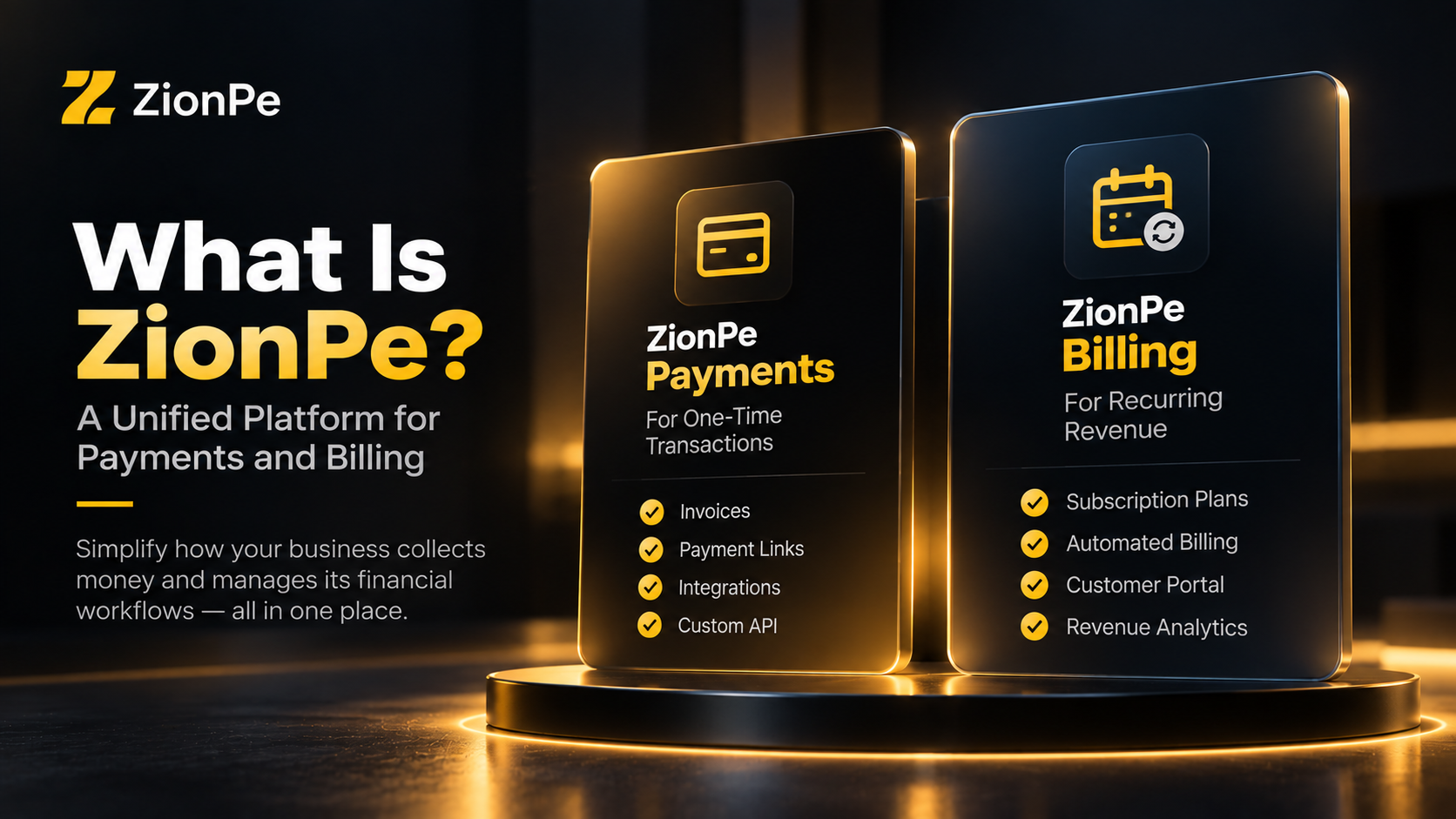
ZionPe is a modern payment and billing platform designed to simplify how businesses collect money and manage their financial workflows.
Instead of requiring businesses to rely on disconnected tools for payment collection, invoicing, customer management, and subscription billing, ZionPe brings these capabilities together through a centralized dashboard.
The platform consists of two complementary products.
ZionPe Payments: For One-Time Transactions
ZionPe Payments is designed for businesses that need to accept and manage payments.
It supports payment collection through invoices, payment links, supported checkout integrations, and custom API implementations.
Businesses can use ZionPe Payments to:
- Accept one-time payments.
- Create and manage invoices.
- Generate shareable payment links.
- Track payment statuses.
- Manage customer records.
- Monitor transactions and balances.
- Access payment and payout information.
Integrate payment collection into supported platforms and custom websites.
For businesses that primarily generate revenue through individual transactions, ZionPe Payments provides a centralized environment for managing payment operations.
ZionPe Billing: For Recurring Revenue
ZionPe Billing is designed for businesses that rely on subscriptions and recurring revenue.
It helps automate the billing process, reducing the need to manually create invoices and manage recurring payment schedules.
With ZionPe Billing, businesses can:
- Create subscription plans.
- Manage recurring billing cycles.
- Automate subscription invoices.
- Offer trials, discounts, and add-ons.
- Support usage-based pricing models.
- Manage subscription changes and cancellations.
- Handle failed-payment recovery workflows.
- Provide customers with a self-service billing portal.
- Monitor recurring revenue performance.
The platform supports flexible billing structures, making it suitable for businesses with different subscription requirements.
One Platform, Two Complementary Products
The real value of ZionPe comes from using these products together.
ZionPe Payments handles payment collection, while ZionPe Billing manages recurring billing logic.
Both products operate within the ZionPe ecosystem, allowing businesses to manage their payment and billing activities through a unified dashboard.
This approach helps reduce the need to switch between multiple platforms to understand how money is collected and how recurring revenue is managed.
3. How ZionPe Reduces Friction in Payment Management
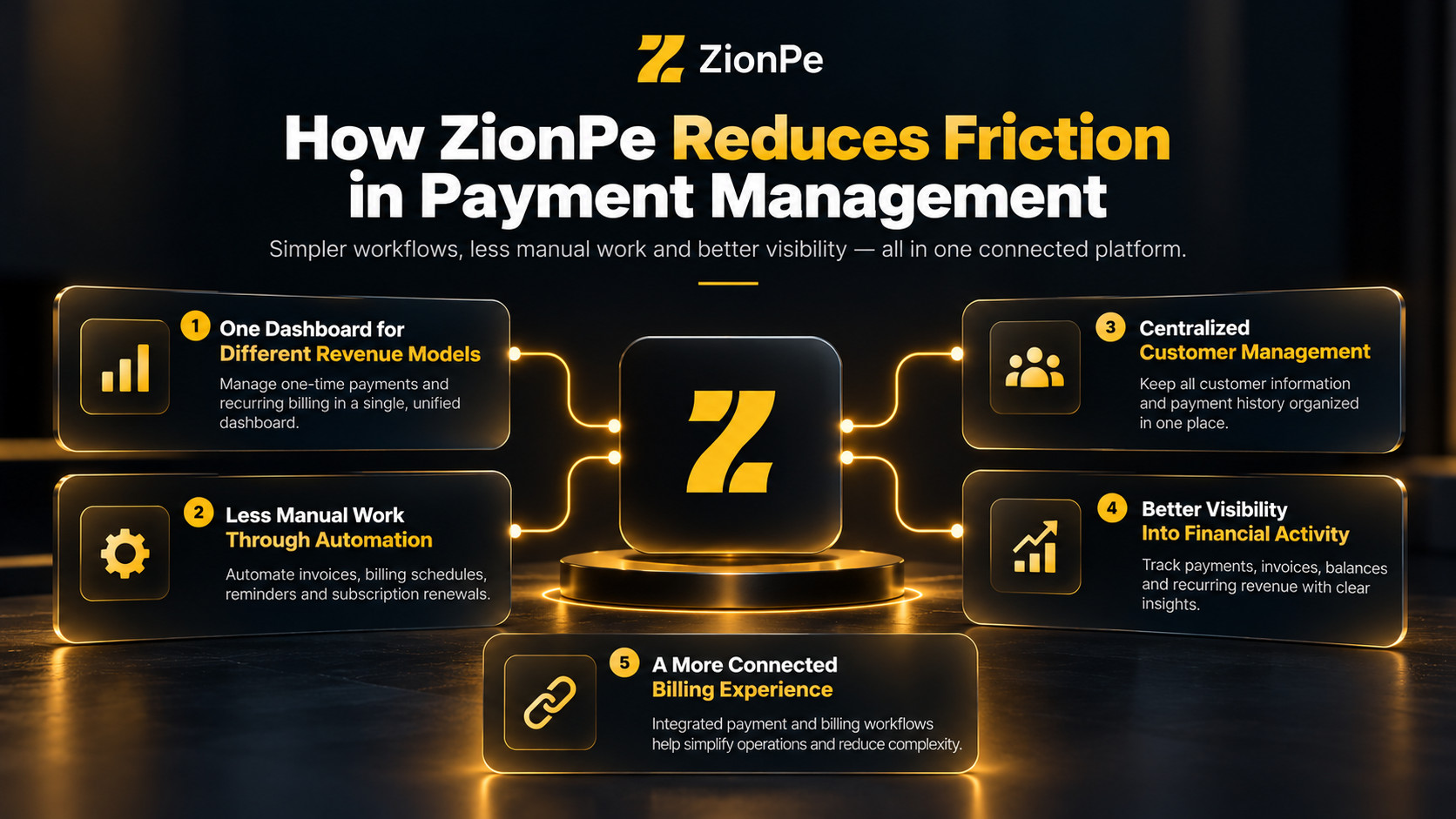
Payment friction is not limited to the checkout experience.
For businesses, friction can also arise from disconnected software, manual reconciliation, inconsistent customer records, and complicated billing workflows.
ZionPe helps reduce these operational challenges in several ways.
A. One Dashboard for Different Revenue Models
One of the biggest challenges for businesses operating multiple revenue models is managing their financial information across separate systems.
A company might use one platform for payment links, another for recurring subscriptions, and a third for customer records.
This fragmented setup can make it difficult to understand the overall financial position of the business.
ZionPe brings payment and billing capabilities together in one dashboard.
Businesses can manage their one-time payment operations through ZionPe Payments and their recurring billing activities through ZionPe Billing.
This centralized approach helps businesses maintain better visibility into their financial operations without constantly switching between different tools.
B. Less Manual Work Through Billing Automation
Manual billing can become increasingly difficult as a business grows.
Creating invoices, tracking payment deadlines, sending reminders, and managing subscription renewals can consume valuable time.
ZionPe helps automate several of these processes.
For one-time transactions, businesses can generate invoices and payment links to simplify payment collection.
For subscriptions, ZionPe Billing can automate recurring invoices, manage billing schedules, and support failed-payment recovery workflows.
This reduces repetitive administrative tasks and allows teams to focus more on customer relationships and business growth.
C. Centralized Customer Management
Customer information is often scattered across payment processors, billing software, and internal databases.
This fragmentation can make it difficult to track payment history and understand customer relationships.
ZionPe provides customer management capabilities that help businesses maintain organized customer records and access relevant payment and billing information.
For businesses managing both one-time purchases and recurring subscriptions, centralized customer information can make financial operations easier to navigate.
D. Better Visibility Into Financial Activity
Businesses need accurate and accessible financial information to make informed operational decisions.
ZionPe provides dashboard-based visibility into payment activity, invoices, balances, and other relevant financial information.
With ZionPe Billing, subscription-focused businesses can also monitor recurring revenue metrics, including monthly recurring revenue, subscription growth, and churn.
This helps businesses understand both their individual transactions and their ongoing revenue streams.
E. A More Connected Billing Experience
When payment collection and subscription management operate separately, teams may need to move information manually between systems.
ZionPe's integrated approach helps connect these workflows.
For example, a business can manage recurring billing through ZionPe Billing while using supported payment methods and payment processing integrations to collect funds.
The result is a more connected financial workflow that can simplify day-to-day operations.
4. How ZionPe Payments and ZionPe Billing Work Together
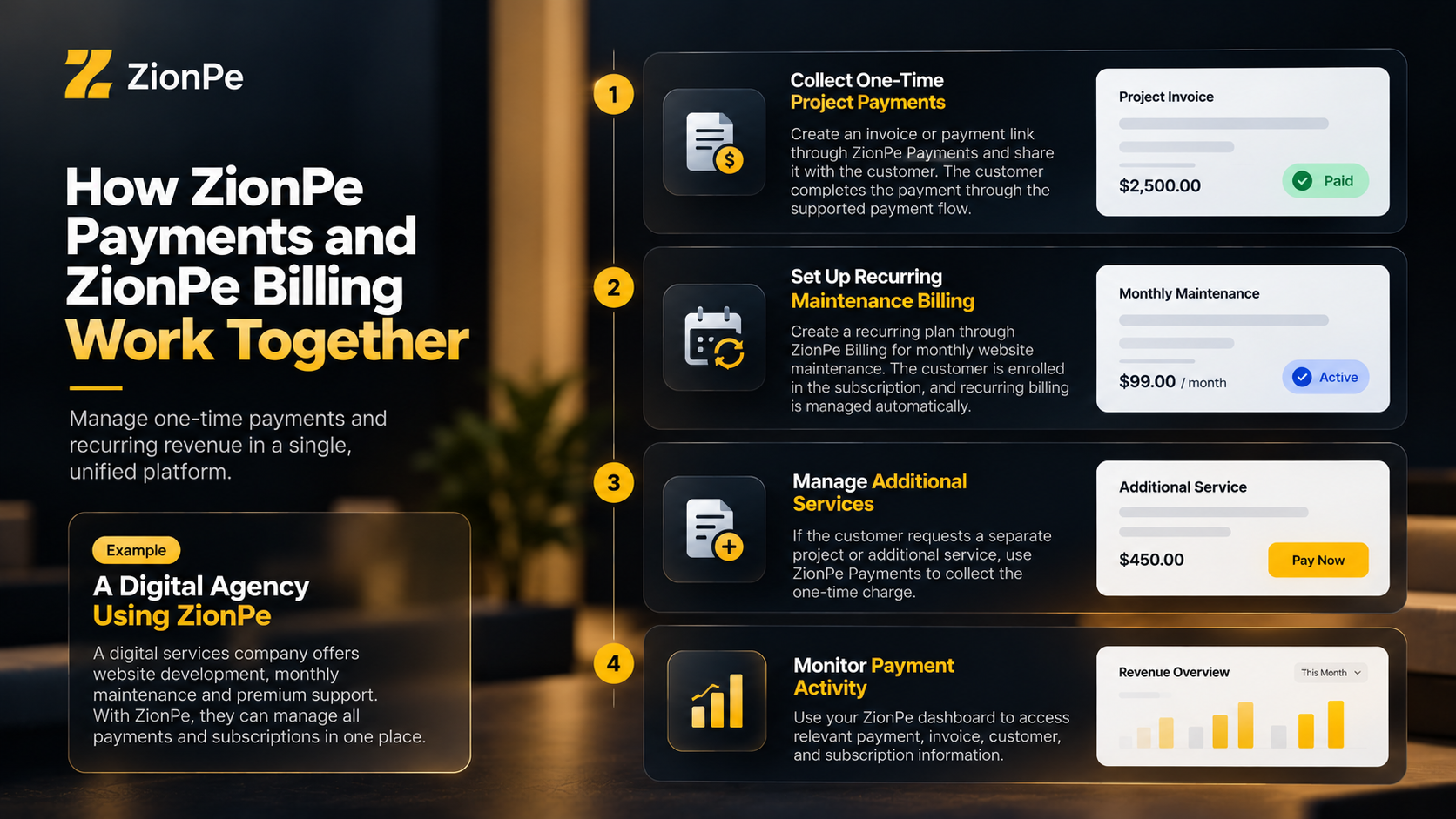
To understand the practical value of ZionPe, consider a business that generates revenue through both one-time payments and subscriptions.
Imagine a digital services company that offers website development, monthly maintenance, and premium support.
Its revenue model includes:
- One-time website development fees.
- Monthly maintenance subscriptions.
- One-time customization charges.
- Recurring premium support packages.
Without a unified payment and billing system, the company might need separate tools to manage project invoices, recurring charges, and customer payment records.
With ZionPe, the company can organize these activities through two complementary products.
Example: A Digital Agency Using ZionPe
Step 1: Collect one-time project payments
The agency creates an invoice or payment link through ZionPe Payments and shares it with the customer.
The customer completes the payment through the supported payment flow.
Step 2: Set up recurring maintenance billing
The agency creates a recurring plan through ZionPe Billing for monthly website maintenance.
The customer is enrolled in the subscription, and recurring billing is managed according to the selected plan.
Step 3: Manage additional services
If the customer requests a separate project or additional service, the agency can use ZionPe Payments to collect the one-time charge.
Step 4: Monitor payment activity
The agency can use its ZionPe dashboard to access relevant payment, invoice, customer, and subscription information.
This creates a more organized way to manage multiple revenue streams without relying on completely separate payment management environments.
5. ZionPe Integrations: Connecting Payments to Your Existing Business
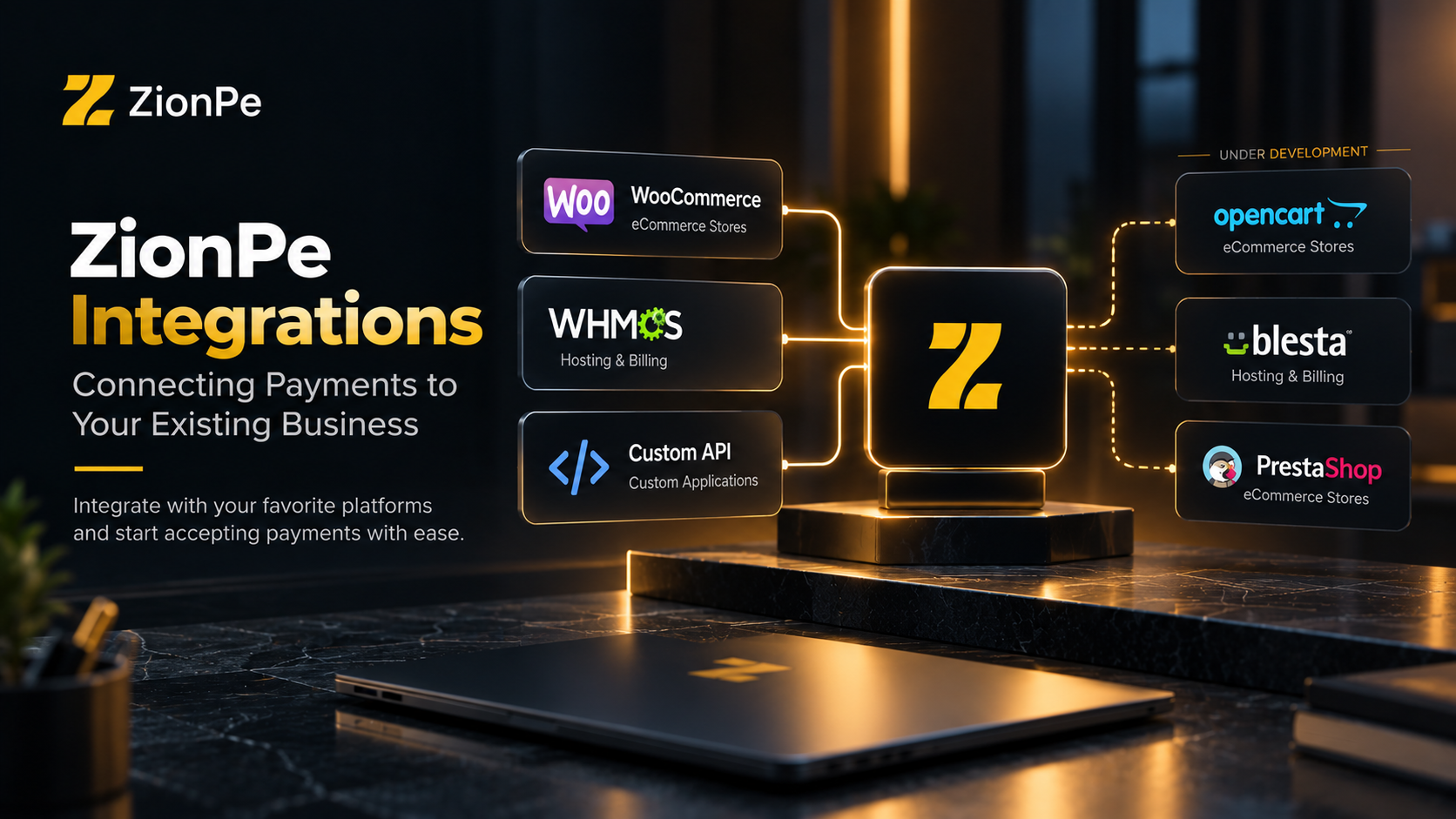
Businesses use different platforms to manage their websites, online stores, hosting services, and billing operations.
A payment platform becomes more useful when it can connect with the tools a business already uses.
ZionPe supports integrations designed to help businesses connect payment collection with their existing infrastructure.
WooCommerce Integration
WooCommerce is widely used by businesses that operate online stores through WordPress.
The ZionPe WooCommerce integration helps merchants connect their online stores with ZionPe Payments to accept payments through their checkout experience.
This is particularly useful for businesses selling physical products, digital products, and other items through a WooCommerce-powered store.
Suitable for:
Online retail stores.
Digital product businesses.
Small and medium-sized eCommerce businesses.
WordPress-based online businesses.
The integration helps businesses connect their store checkout with their payment management workflow.
WHMCS Integration
WHMCS is commonly used by hosting providers and digital infrastructure businesses to manage clients, invoices, and recurring services.
ZionPe's WHMCS integration supports payment collection through WHMCS invoices and can support saved-card payments and automatic renewals when recurring payments are enabled.
This makes it relevant for businesses that need to manage recurring customer billing alongside individual invoices.
Suitable for:
Web hosting providers.
Domain registration businesses.
Cloud service providers.
Managed IT service companies.
Businesses selling recurring digital infrastructure services.
By connecting payment processing with WHMCS, businesses can streamline payment collection and keep invoice records synchronized with their ZionPe dashboard.
Custom API Integration
Every business has different technical requirements.
Some companies operate custom websites, SaaS applications, marketplaces, or proprietary platforms that cannot rely on standard plugins.
ZionPe provides a Custom API integration that allows developers to connect payment functionality with their own websites and applications.
This makes it possible to integrate supported payment flows into custom-built digital products.
Suitable for:
- SaaS platforms.
- Custom eCommerce websites.
- Web applications.
- Digital marketplaces.
- Software companies.
- Businesses with in-house development teams.
The Custom API gives businesses greater flexibility in designing payment experiences around their existing systems.
Additional Integrations Under Development
ZionPe is also working on expanding its integration ecosystem.
The following integrations are currently under development and are planned for future release:
Integration Primary Use Case
OpenCart
eCommerce stores
Blesta
Hosting and client billing
PrestaShop
eCommerce stores
These integrations are intended to extend ZionPe's compatibility with additional eCommerce and billing platforms.
Note: OpenCart, Blesta, and PrestaShop integrations are under development and should not be considered available until their official release.
Businesses using these platforms can follow ZionPe's official updates for information about future availability.
6. Which Businesses Can Benefit From ZionPe?
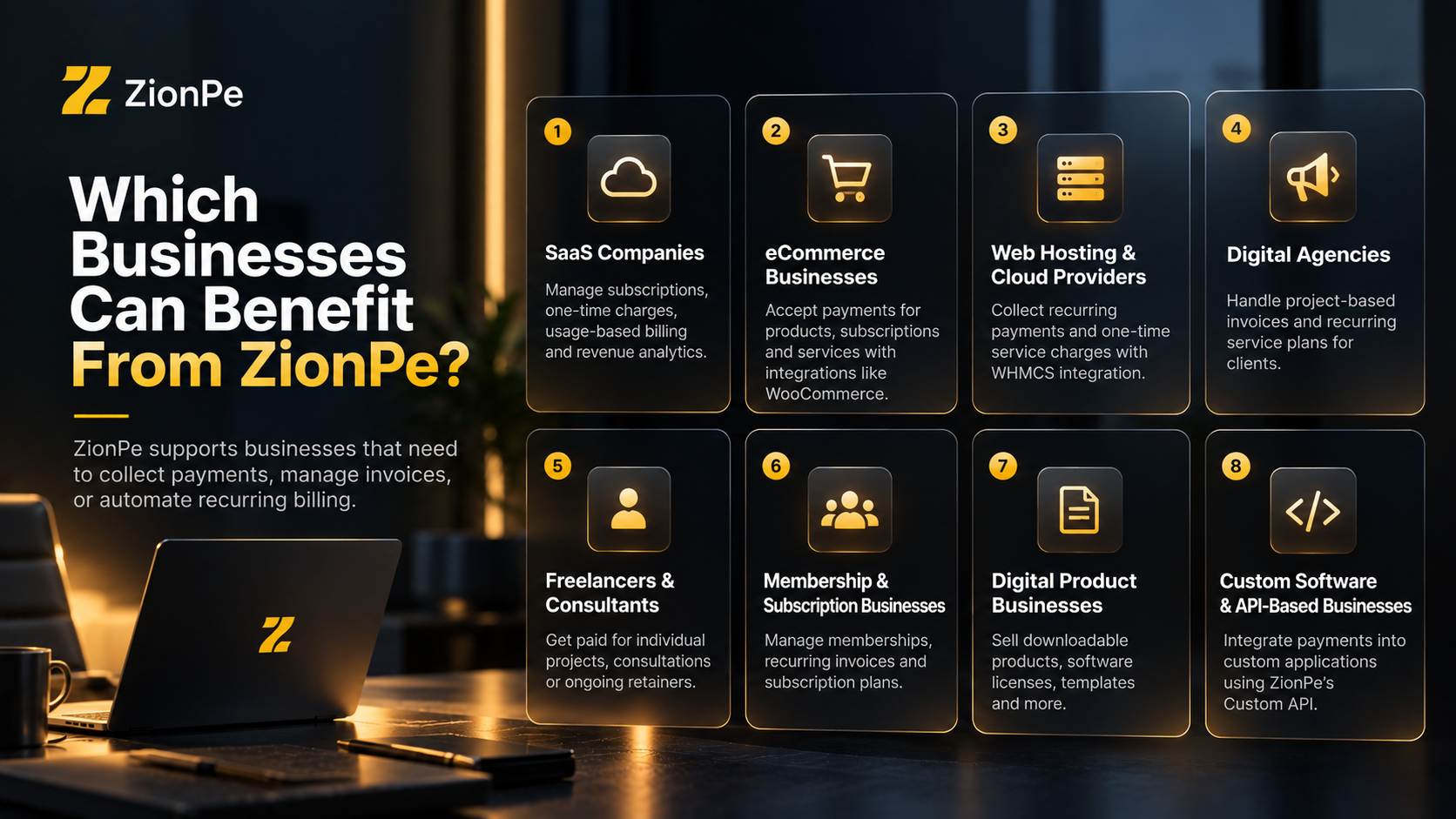
ZionPe is designed to support businesses that need to collect payments, manage invoices, or automate recurring billing.
Its suitability depends on the business model, operational requirements, and the payment capabilities needed.
Here are some of the business categories that may benefit from the platform.
1. SaaS Companies
SaaS businesses often combine recurring subscriptions with one-time charges.
For example, a software company might charge customers a monthly subscription while collecting separate payments for onboarding, customization, or additional services.
ZionPe can help these businesses manage recurring billing through ZionPe Billing and individual transactions through ZionPe Payments.
Relevant capabilities include subscription management, recurring invoices, usage-based billing, and revenue analytics.
2. eCommerce Businesses
Online stores typically generate revenue through individual customer purchases.
However, some eCommerce businesses also offer recurring product subscriptions, memberships, or ongoing services.
ZionPe Payments can help merchants manage payment collection through supported payment links, invoices, and integrations such as WooCommerce.
Businesses with subscription-based offerings can also explore ZionPe Billing for recurring billing workflows.
3. Web Hosting and Cloud Service Providers
Hosting companies frequently rely on recurring monthly or annual billing.
They may also charge one-time setup fees, migration fees, or additional service charges.
ZionPe's WHMCS integration can help connect payment collection with hosting-related invoices and recurring payment workflows.
ZionPe Billing can also support businesses that need subscription management and recurring billing capabilities.
4. Digital Agencies
Digital agencies often have a combination of project-based and recurring revenue.
For example, an agency might charge a one-time fee for website development and a recurring monthly fee for maintenance or marketing services.
ZionPe Payments can support individual project invoices and payment links, while ZionPe Billing can help manage recurring service plans.
This makes the platform relevant for agencies looking to organize different revenue streams in one place.
5. Freelancers and Consultants
Freelancers and consultants frequently charge clients for individual projects, consultations, or professional services.
Some also offer ongoing retainers or monthly service packages.
ZionPe Payments can help manage one-time invoices and payment links, while ZionPe Billing can support recurring billing arrangements.
This can help independent professionals organize payment collection without relying entirely on manual invoicing.
6. Membership and Subscription Businesses
Membership-based businesses generate recurring revenue by providing ongoing access to content, services, or communities.
Examples include:
- Online learning memberships.
- Premium content platforms.
- Professional communities.
- Subscription-based digital services.
- Membership websites.
ZionPe Billing can help these businesses manage subscription plans, recurring invoices, and customer billing workflows.
For businesses that also sell individual products or services, ZionPe Payments can complement their subscription operations.
7. Digital Product and Software License Businesses
Businesses selling downloadable products, software licenses, templates, or digital resources often rely on one-time payments.
Some also offer recurring access to premium features, updates, or ongoing services.
ZionPe Payments can support individual transactions, while ZionPe Billing can help manage recurring subscription offerings.
This makes the platform relevant for digital businesses with mixed revenue models.
8. Custom Software and API-Based Businesses
Companies operating custom applications or proprietary platforms may need payment functionality that integrates directly into their existing systems.
ZionPe's Custom API can help developers connect supported payment functionality with their applications.
Businesses that offer recurring services can also explore ZionPe Billing for subscription and recurring billing management.
When Should You Use ZionPe Payments?
ZionPe Payments is suitable for businesses that primarily need to accept and manage individual transactions.
It is particularly relevant for businesses that rely on invoices, payment links, supported checkout integrations, or custom payment implementations.
When Should You Use ZionPe Billing?
ZionPe Billing is suitable for businesses that need to manage recurring revenue and automate subscription-related processes.
It is particularly relevant for SaaS companies, membership platforms, hosting providers, and businesses offering recurring services.
When Should You Use Both?
Businesses that generate revenue through both individual transactions and recurring subscriptions can use ZionPe Payments and ZionPe Billing together.
For example, a software company might use ZionPe Payments for implementation fees and ZionPe Billing for monthly subscriptions.
This approach helps businesses manage different revenue models within a connected payment and billing environment.
7. How a Unified Dashboard Supports Business Growth
As businesses grow, their payment operations often become more complex.
More customers mean more transactions, more invoices, and potentially more subscription plans.
Without a structured system, managing these activities can become increasingly time-consuming.
A unified dashboard can help address several operational challenges.
Improved Financial Visibility
Having payment and billing information accessible through one platform helps businesses monitor their financial activity more efficiently.
Teams can access relevant information about transactions, invoices, customers, and subscriptions without relying entirely on disconnected systems.
More Efficient Billing Operations
Automated recurring billing reduces the need to manually process every subscription invoice.
This becomes particularly valuable for businesses with a growing customer base and multiple billing schedules.
Better Customer Payment Management
Centralized customer records and billing information can help businesses understand payment history and manage outstanding invoices.
This can also make it easier to identify billing issues that require attention.
Greater Operational Flexibility
Businesses may introduce new products, services, or pricing models as they grow.
A platform that supports both one-time payments and recurring billing can help accommodate these different revenue streams without requiring an entirely separate payment system for every new offering.
A More Organized Business Workflow
When payment collection, invoicing, and subscription management are connected, teams can spend less time navigating between systems.
This creates a more organized operational environment and helps businesses manage their financial workflows as their needs evolve.
8. Why Businesses Need More Than a Payment Gateway
A traditional payment gateway primarily focuses on facilitating transactions.
However, modern businesses often need additional tools to manage the broader financial lifecycle.
These requirements include:
- Customer management.
- Invoice creation and tracking.
- Recurring billing automation.
- Subscription lifecycle management.
- Failed-payment recovery.
- Financial reporting.
- Integration with existing business software.
ZionPe brings several of these capabilities together through ZionPe Payments and ZionPe Billing.
Rather than treating one-time payments and recurring billing as entirely separate operational functions, the platform provides businesses with a connected environment for managing both.
This is particularly relevant for companies that are transitioning from a single revenue model to a combination of individual transactions and recurring services.
9. Getting Started With ZionPe
Businesses interested in using ZionPe can begin by identifying their primary payment and billing requirements.
Step 1: Identify Your Revenue Model
Determine whether your business relies on one-time payments, recurring subscriptions, or a combination of both.
This will help you identify whether ZionPe Payments, ZionPe Billing, or both products are relevant to your operations.
Step 2: Explore the Available Integrations
If you operate an existing website or business platform, check whether ZionPe supports an integration that matches your setup.
Available options include WooCommerce, WHMCS, and Custom API.
OpenCart, Blesta, and PrestaShop integrations are under development and are planned for future release.
Step 3: Configure Your Payment and Billing Workflows
Set up the relevant payment collection methods, invoicing processes, and subscription plans based on your business requirements.
Businesses using custom applications can explore the available API documentation to understand the integration process.
Step 4: Manage Your Operations Through the Dashboard
Once your account and relevant payment workflows are configured, use the ZionPe dashboard to access your payment, invoice, customer, and billing information.
The goal is to create a more connected environment for managing your business's financial activities.
To explore the platform and its available capabilities, visit ZionPe.
Conclusion:
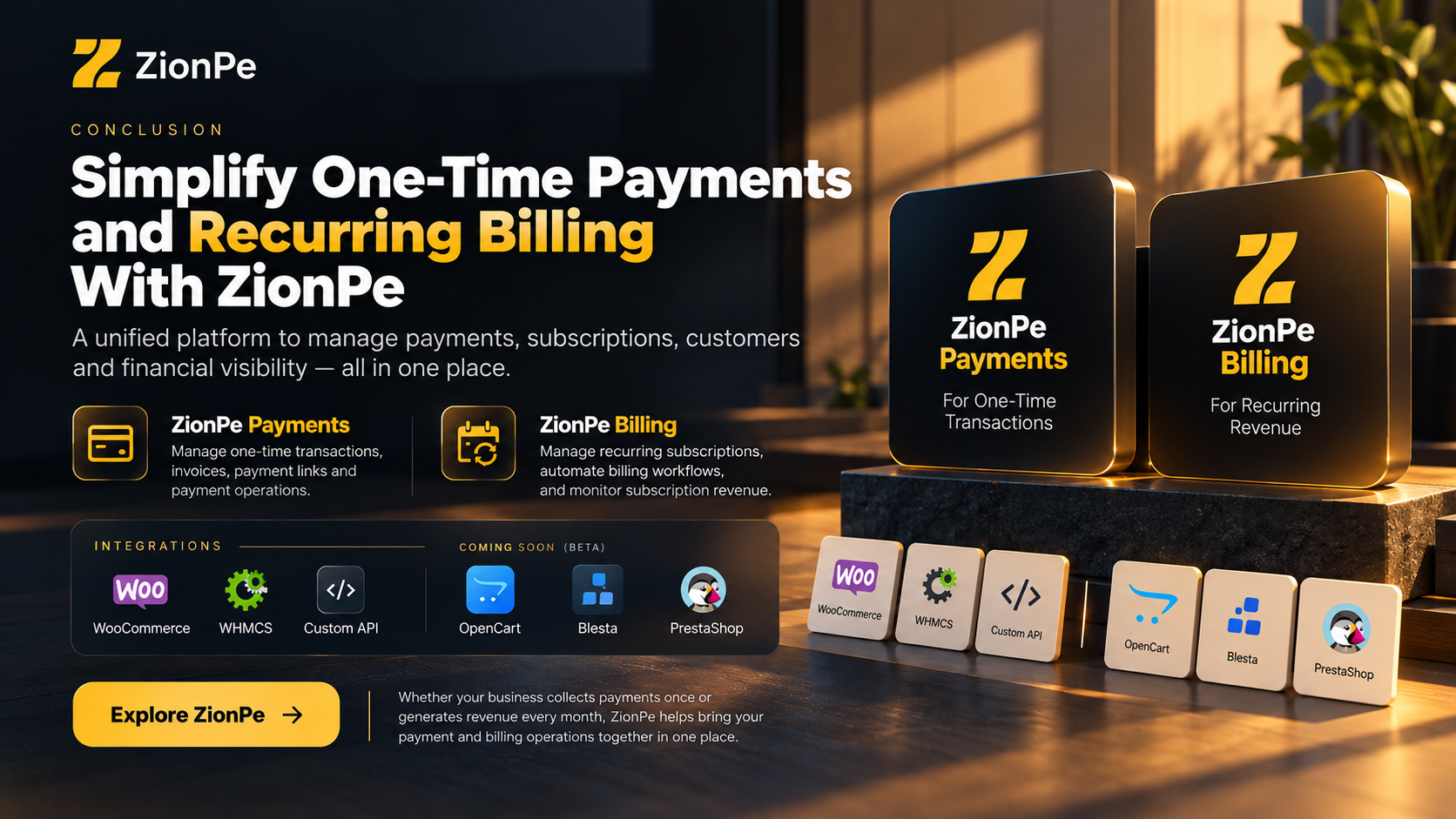
Simplify One-Time Payments and Recurring Billing With ZionPe
Managing multiple revenue models does not have to mean managing multiple disconnected systems.
Businesses that accept one-time payments while offering subscriptions need a flexible approach to payment collection, billing automation, customer management, and financial visibility.
ZionPe addresses these needs through two complementary products.
ZionPe Payments helps businesses manage one-time transactions, invoices, payment links, and payment operations.
ZionPe Billing helps businesses manage recurring subscriptions, automate billing workflows, and monitor subscription revenue.
Together, they provide a unified platform where businesses can manage different revenue streams through a centralized dashboard.
With integrations for WooCommerce, WHMCS, and Custom API, ZionPe also helps businesses connect payment functionality with their existing digital infrastructure.
Additional integrations for OpenCart, Blesta, and PrestaShop are under development but you can use them in beta.
From eCommerce stores and SaaS platforms to digital agencies, hosting providers, freelancers, and membership businesses, ZionPe offers capabilities that can support a range of payment and billing requirements.
Whether your business collects payments once or generates revenue every month, ZionPe helps bring your payment and billing operations together in one place.
Ready to Simplify Your Payment and Billing Operations?
Explore ZionPe and discover how its payment and billing capabilities can support your business.
Visit zionpe.com to get started.