.svg)
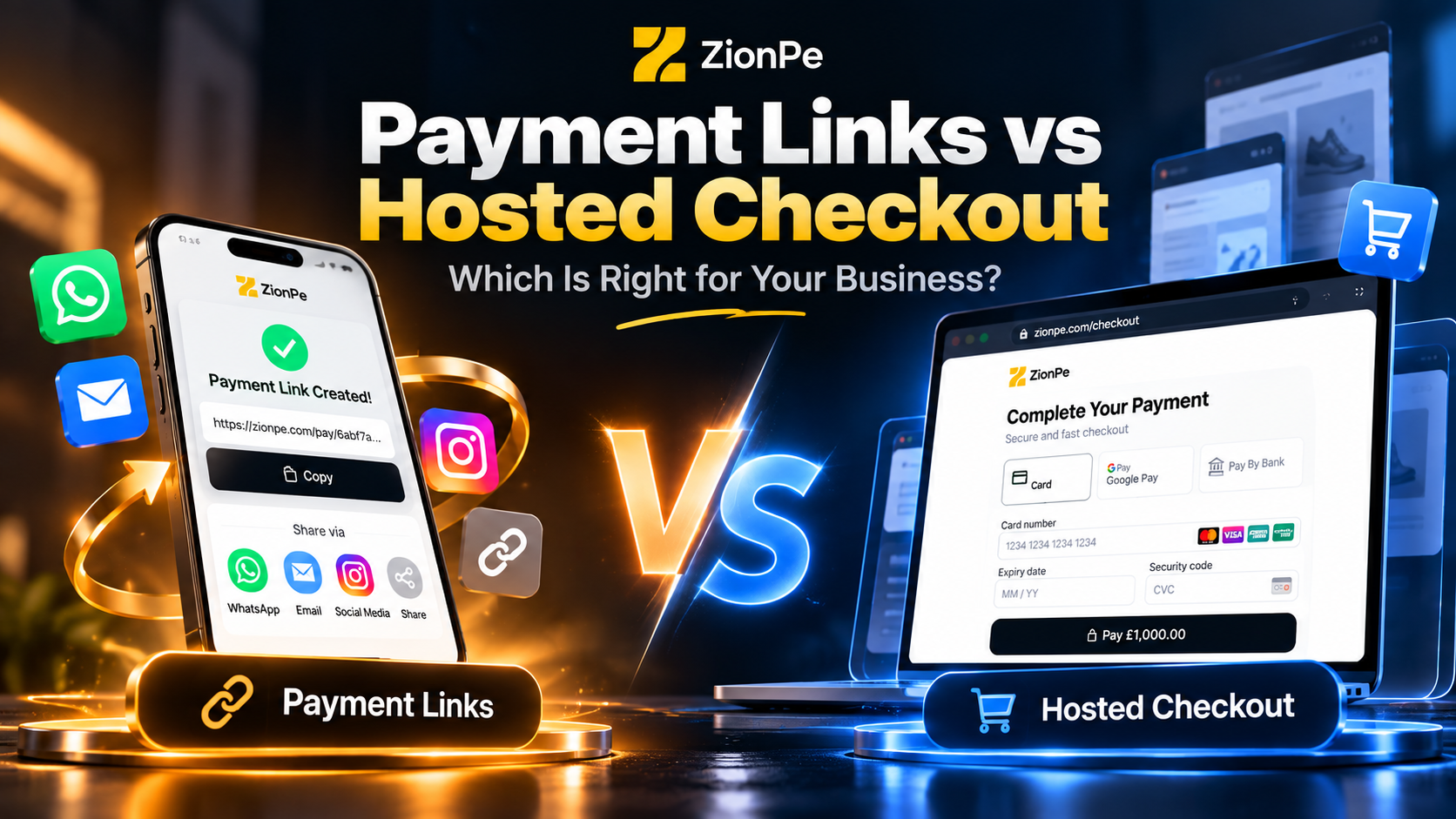

Getting paid online should be one of the simplest parts of running a business. Yet for many founders, freelancers, agencies, SaaS companies, and online sellers, setting up the right payment experience can quickly become complicated.
Should you send customers a payment link? Should you integrate a hosted checkout directly into your website? Do you need both?
The answer depends largely on how you sell.
The good news is that businesses don't necessarily have to choose one approach forever. Modern payment platforms can provide both options, allowing businesses to use payment links when speed and flexibility matter and hosted checkout when they want a more integrated website or app experience.
This is where ZionPe comes in. ZionPe brings payment links and hosted checkout together in a single dashboard, allowing businesses to choose the payment method that fits each customer and sales channel without managing multiple complicated payment systems.
Let's look at the difference.
What Is a Payment Link?
A payment link is a unique URL that takes a customer to a secure payment page.
Instead of building a checkout experience on your website, you create a payment link, specify the amount and payment details, and share the link with your customer.
The customer clicks the link, completes the payment, and you receive confirmation.
For example, imagine a digital marketing agency has completed a £1,500 project for a client. Rather than asking the client to navigate through the agency's website, the agency can simply create a payment link and send it by email or WhatsApp.
The customer clicks, pays, and the transaction is completed.
According to ZionPe, its payment links can be shared through email, WhatsApp, social media, live chat, or invoices, and businesses don't need a website to use them.
Payment links are particularly useful for:
- Freelancers
- Consultants
- Agencies
- Coaches and creators
- Service businesses
- Social media sellers
- Businesses selling through WhatsApp
- Businesses that don't have an e-commerce website
- One-off invoices and payments
- Recurring services
The biggest advantage is simplicity.
You don't necessarily need developers, custom checkout pages, or a complex website integration. You create the link and share it wherever your customer is already communicating with you.
What Is Hosted Checkout?
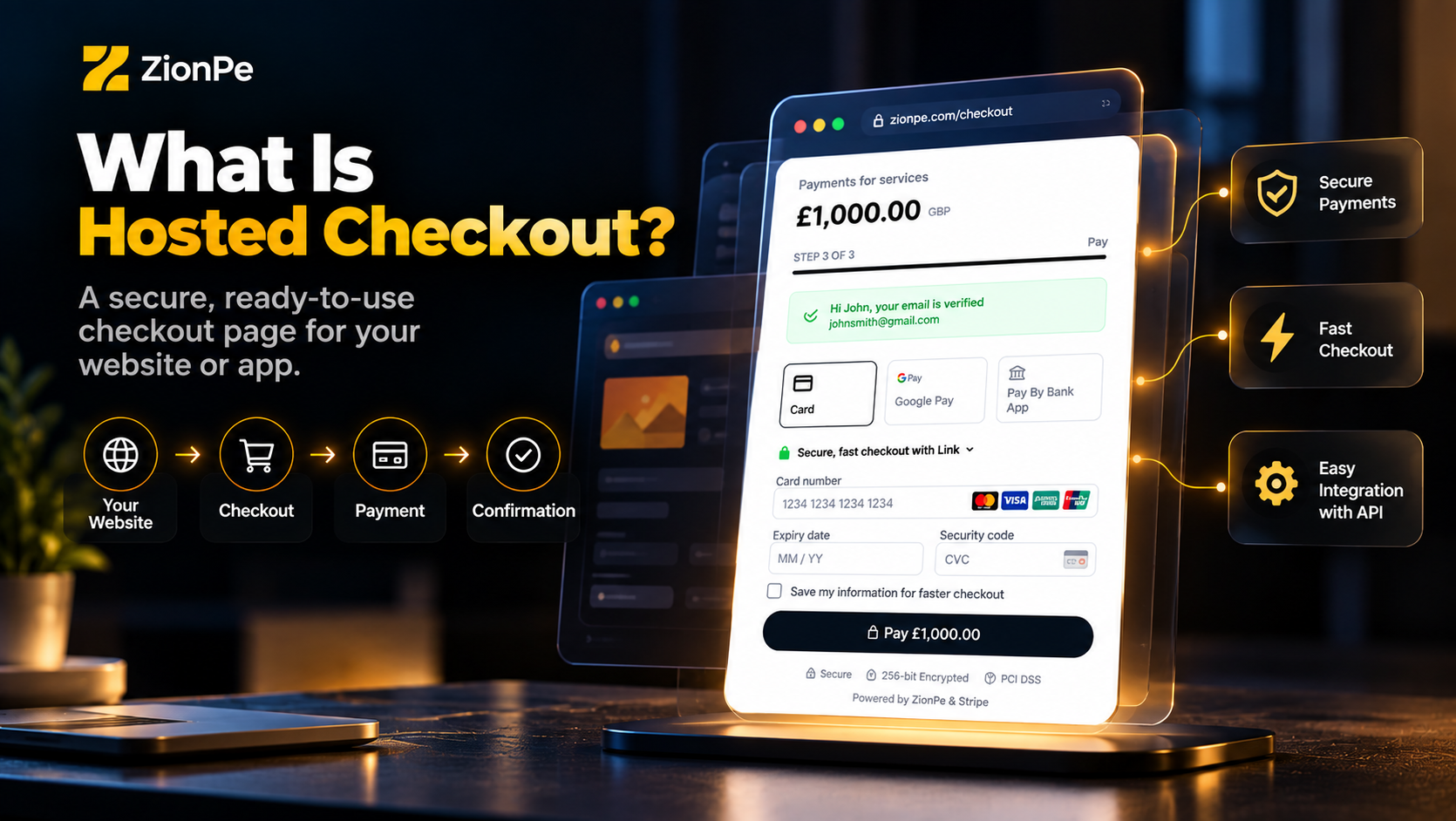
Hosted checkout takes the concept a step further.
Instead of sending customers a generic payment request through a conversation, you can direct them from your website or application to a dedicated, secure checkout page hosted by your payment provider.
The customer can review the purchase and complete payment through the hosted checkout environment.
For example:
Your website → Checkout → Payment → Confirmation
The checkout experience is still handled by the payment provider, but it is triggered as part of your website or application journey.
This can be particularly useful for e-commerce businesses, SaaS companies, online platforms, and businesses selling products or services directly through their websites.
ZionPe's hosted checkout can be integrated with a website or app through its checkout API. Its documentation explains that a business can create a checkout session from its server, redirect the customer to the hosted checkout page, and receive payment notifications through webhooks.
Payment Links vs Hosted Checkout
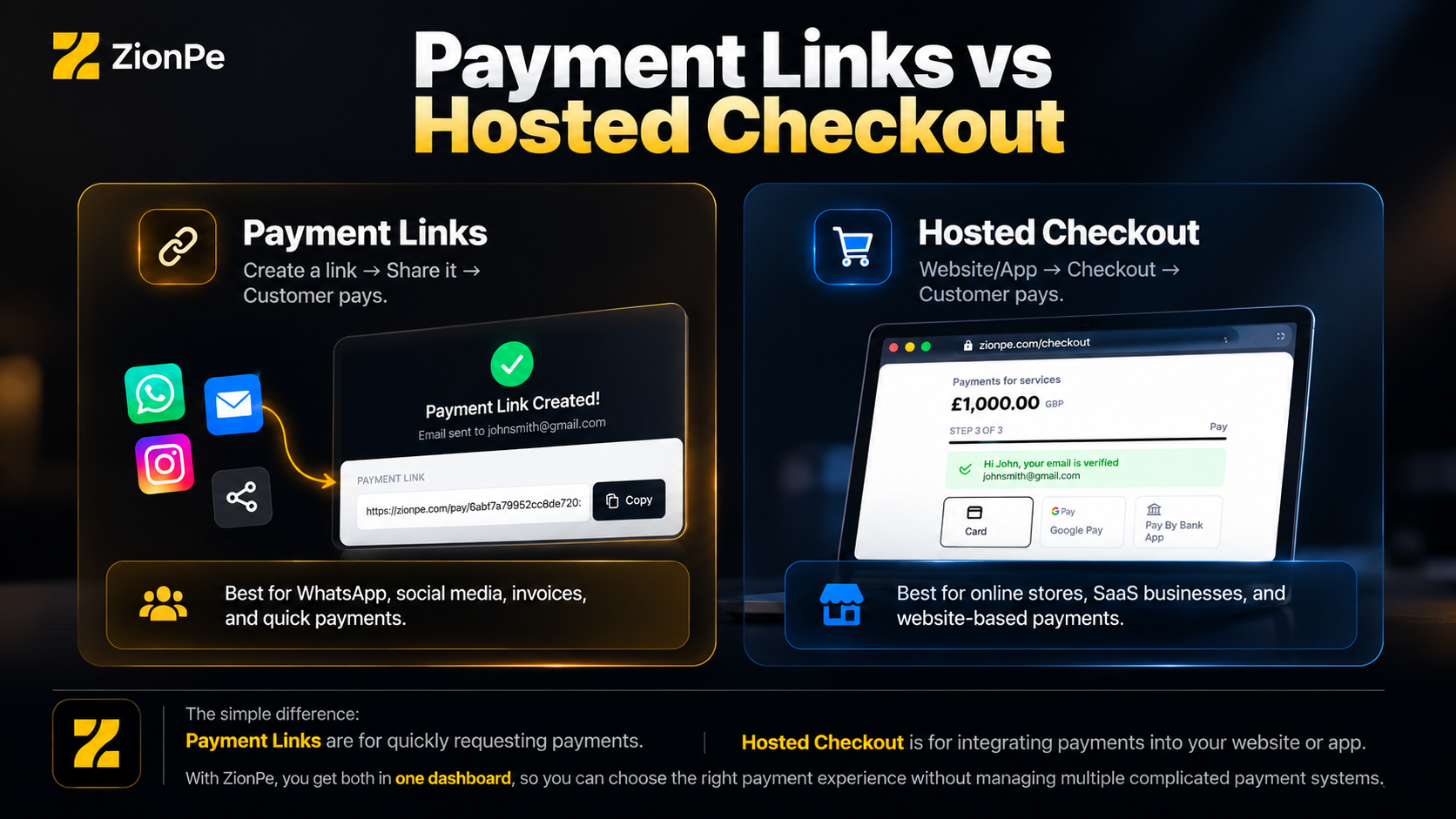
Payment Links:
Create a link → Share it → Customer pays.
Best for WhatsApp, social media, invoices, and quick payments.
Hosted Checkout:
Website/App → Checkout → Customer pays.
Best for online stores, SaaS businesses, and website-based payments.
The simple difference:
Payment Links are for quickly requesting payments.
Hosted Checkout is for integrating payments into your website or app.
With ZionPe, you get both in one dashboard, so you can choose the right payment experience without managing multiple complicated payment systems.
When Should You Use Payment Links?
Payment links make sense when speed, flexibility, and convenience are more important than building a sophisticated checkout journey.
1. You're a freelancer or consultant
Suppose you're a freelance designer, developer, consultant, or copywriter.
You finish a project and need to collect £800.
You don't necessarily need an entire e-commerce checkout system.
You need to get paid.
Create a payment link, send it to the client, and you're done.
2. You sell through WhatsApp or social media
Not every business starts with a sophisticated online store.
Many businesses generate leads through Instagram, Facebook, LinkedIn, WhatsApp, or other channels.
A payment link turns that conversation into a payment opportunity.
Instead of saying:
"Please visit our website and find the payment page..."
You can simply send the payment link.
3. You don't have a website
A website isn't always necessary to start accepting online payments.
ZionPe specifically positions payment links as a way to accept payments without building a website. Businesses can create a link, share it, and send customers to a secure checkout page.
4. You send invoices
Payment links can also work naturally alongside invoicing.
For example:
Invoice → Payment Link → Customer Payment → Payment Status Updated
ZionPe allows payment links to be connected with invoices so that payments can update invoice status within the platform.
When Should You Use Hosted Checkout?
Hosted checkout becomes particularly valuable when your website or application is already an important part of the sales process.
1. You operate an e-commerce website
If customers are already browsing products on your website, sending them somewhere else to manually arrange payment may create unnecessary friction.
A hosted checkout can become part of a more structured purchase journey:
Product → Cart → Checkout → Payment → Confirmation
2. You run a SaaS business
For SaaS companies, customers may need to select a plan, enter account information, choose a payment method, and complete a subscription.
A hosted checkout can support this type of structured journey.
3. You have a custom website or application
Businesses with custom platforms often want customers to initiate payment directly from their application.
ZionPe's API allows a website or app to create a hosted checkout session and redirect the customer to ZionPe's payment page. Payment status can then be communicated back to the business through webhooks.
4. You want a more integrated customer journey
Hosted checkout is generally more suitable when payment is one part of a larger digital experience rather than something you're simply requesting from a customer.
So, Which One Is Right for Your Business?
The answer depends on your sales model.
If you're primarily selling through conversations, invoices, email, WhatsApp, social media, or direct client relationships, payment links may be the simplest option.
If customers primarily purchase through your website or application, hosted checkout may be more appropriate.
But here's an important point:
Your business may need both.
A business doesn't always sell in just one way.
Consider an agency.
A new client might discover the agency through its website and purchase a service through a website checkout.
Another client may receive a proposal over email and need a payment link.
A third client may receive an invoice after completing a project.
Trying to force all three customers through exactly the same payment process isn't necessarily the most efficient approach.
This is why having both options available from one platform can be useful.
ZionPe: Payment Links and Hosted Checkout in One Dashboard
This is where ZionPe takes a different approach.
Instead of making businesses choose between separate payment tools, ZionPe brings multiple payment capabilities into a single platform.
Its payment infrastructure includes payment links, invoices, hosted checkout, integrations, and payment management, allowing businesses to use different payment methods depending on how they sell.
With ZionPe, you can:
Create a payment link
Generate a payment link and share it through email, WhatsApp, social media, or other channels.
Use hosted checkout
For businesses with websites or applications, ZionPe provides hosted checkout capabilities through its API.
Send invoices
Create branded invoices with hosted payment functionality and track payment status.
Manage customers
Keep customer and payment information organized within the same platform.
Monitor payments
View payment activity, balances, and reporting from one dashboard.
The key idea is simple:
One business. Multiple ways to get paid. One dashboard.
The Real Advantage: You Don't Have to Overcomplicate Payments
Payment technology has a reputation for being complicated.
There are gateways, APIs, checkout pages, webhooks, payment methods, invoices, subscriptions, fraud controls, reporting, and integrations.
For a developer, these are familiar concepts.
For a business owner, they're often just another layer of operational complexity.
That's why simplicity matters.
ZionPe positions its platform around bringing payments, invoicing, payment links, subscriptions, customers, and reporting together rather than requiring businesses to manage disconnected tools.
Instead of asking:
"Which payment system do I need?"
you can think about the simpler question:
"How does this customer want to pay?"
If the answer is through WhatsApp, send a payment link.
If the answer is through your website, use hosted checkout.
If the customer needs an invoice, send an invoice with payment functionality.
The underlying payment management can remain in the same place.
Payment Links and Hosted Checkout Can Work Together
It's easy to think of payment links and hosted checkout as competing technologies.
In reality, they can complement each other.
Consider an online consulting business.
Customer A: Website visitor
They find the company's website, select a service, and click Pay Now.
Hosted Checkout
Customer B: Existing client
The consultant finishes a project and sends the client an invoice through email.
Payment Link / Invoice Payment
Customer C: Social media customer
Someone discovers the consultant through LinkedIn and wants to purchase a consultation.
Payment Link
Customer D: Recurring customer
The client signs up for a recurring service.
Subscription Billing
Four different customer journeys.
One business.
The most practical payment infrastructure is therefore not necessarily the one that forces everyone into the same process. It's the one that gives the business flexibility without creating unnecessary operational complexity.
What About Security?
Security is another reason businesses often choose hosted payment experiences.
With hosted checkout, sensitive payment information can be handled by the payment provider rather than requiring the business to build and maintain its own card-data infrastructure.
ZionPe's hosted checkout documentation describes a flow in which customers are redirected to ZionPe's payment page, while the business receives payment events through webhooks.
ZionPe also states that its checkout supports 3D Secure and that card data isn't stored on ZionPe.
For businesses, this can reduce the amount of payment infrastructure they need to build themselves.
Final Thoughts
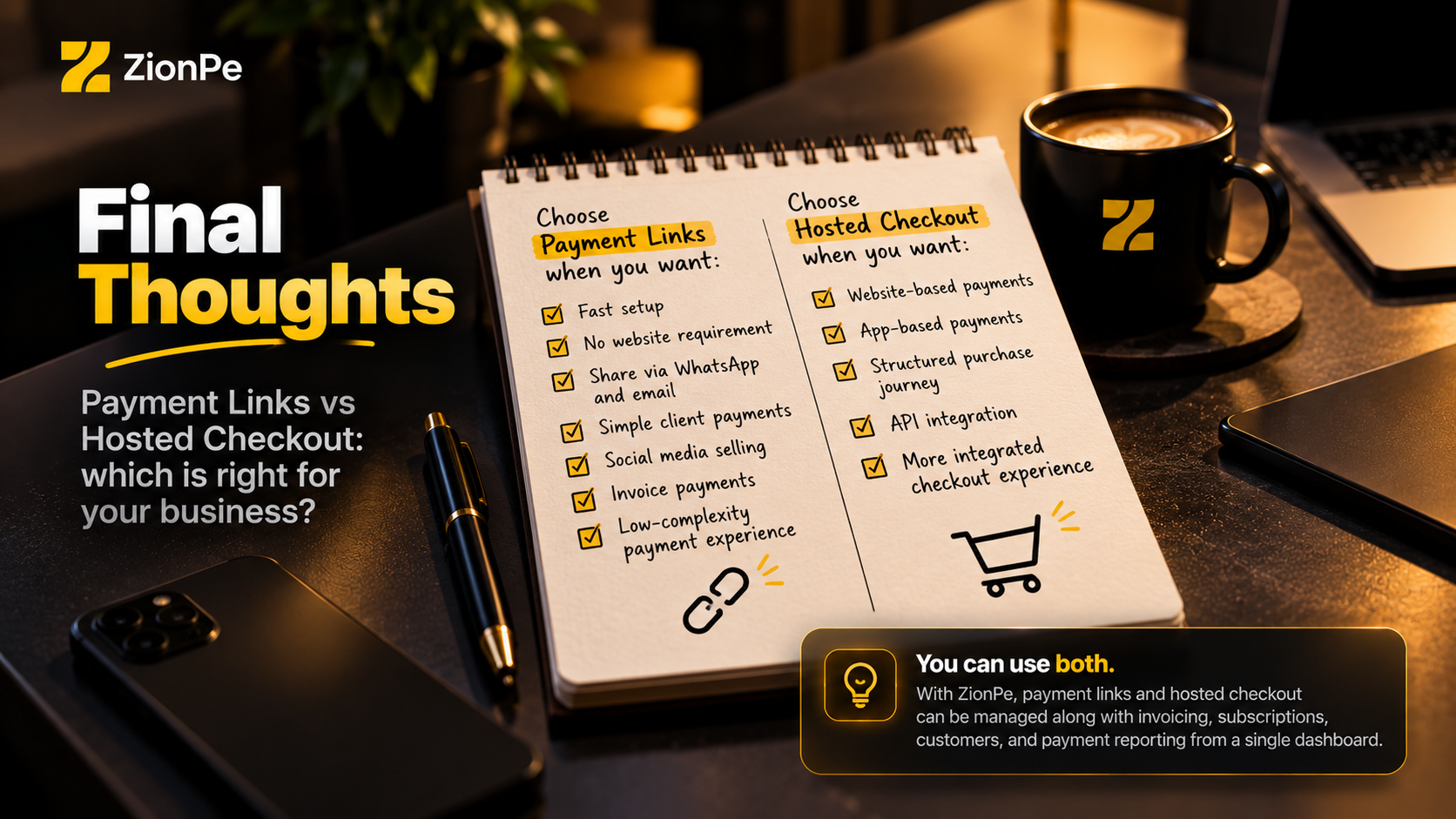
So, Payment Links vs Hosted Checkout: which is right for your business?
It depends on how you sell.
Choose payment links when you want:
- Fast setup
- No website requirement
- Easy sharing through WhatsApp and email
- Simple client payments
- Social media selling
- Invoice payments
- A low-complexity payment experience
Choose hosted checkout when you want:
- Website-based payments
- App-based payments
- A structured online purchase journey
- API integration
- A more integrated checkout experience
But if your business uses multiple sales channels, you may not need to choose one.
You can use both.
That's the practical advantage of a platform such as ZionPe, where payment links and hosted checkout can be managed alongside invoicing, subscriptions, customers, and payment reporting from a single dashboard.
For a business owner, the goal isn't to build the most complicated payment infrastructure.
It's to make getting paid simple for you and simple for your customers.
And sometimes, the best payment strategy is simply having the right option available at the right moment.
Ready to simplify how your business gets paid?
Explore ZionPe and see how payment links, hosted checkout, invoicing, and other payment tools can work together from one dashboard.